Retour à la section :
Culture/Pollinisation
Tableau des groupes d'incompatibilité chez les cerisier doux - Christian Sauvé
Il existe de nombreuses variables empêchant l’autofécondation chez les plantes. L’auto-incompatibilité peut être due à la morphologie de la fleur : positionnement des étamines par rapport au pistil par exemple. Mais chez un grand nombre d’espèces fruitières (cerisier doux, amandier, pommier, abricotier…), elle est d’origine génétique. Cette auto-incompatibilité d’origine génétique repose sur des gènes d’incompatibilité (S) existant sous forme de nombreux allèles (S1, S2, S3...) (figure 1) et s’exprime lorsqu’un grain de pollen essaie de féconder une fleur. Si un grain de pollen se pose sur le pistil de la même fleur, un processus biochimique empêche le pollen de terminer son développement et de féconder l’ovule. Ce processus biochimique repose sur des réactions enzymatiques qui sont encore mal connues et à l’étude chez de nombreuses espèces fruitières.
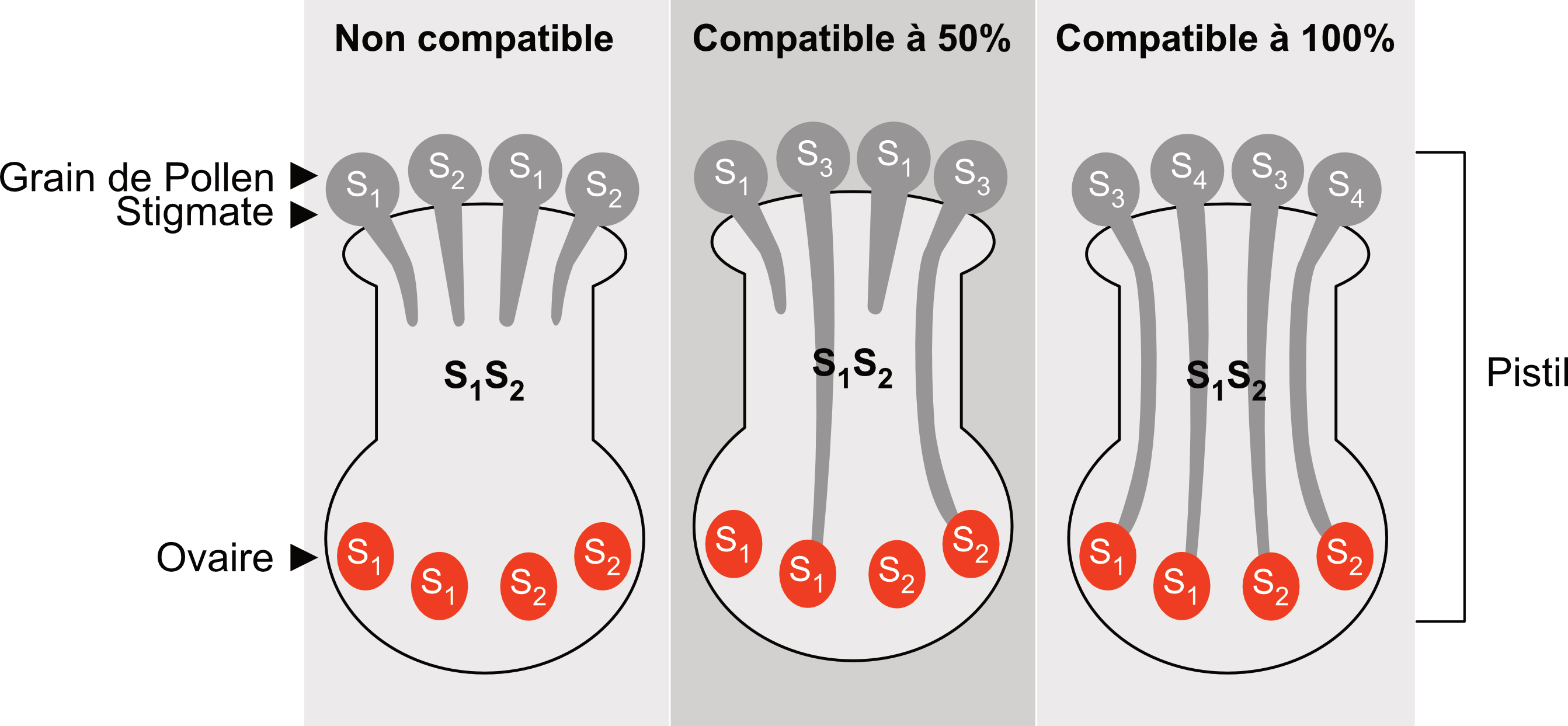
Pour un pistil ayant S1 et S2, un autre arbre portant S3 et S4 sera complètement compatible alors qu’un arbre portant S3 et S1 sera semi-compatible et enfin un arbre portant exactement le même génotype (S1S2) sera complètement incompatible. Ces observations seront vraies quel que soit le sens du croisement (variétés pollinisatrice ou pollinisée).
| Cultivar |
Génotype |
Groupe d'incompatibilité |
Origine |
Mère |
Père |
Références |
RÉFÉRENCES :
1. Way, R.D. (1968). Pollen incompatibility groups of sweet cherry clones. Proc. Amer. Soc. Hort.Sci. 92, 119-123.
2. Schmidt, H. (1982). Inkompatibilitätsgruppen bei Süßkirschen. Erwerbsobstbau 24, 6-9.
3. Ershadi, A. and Moghadam, E.H. (2009). Identification of S-Alleles in 25 sweet cherry (Prunusavium L.) cultivars by allele-specific PCR amplification. Acta Hort. 814, 619-621.
4. Matthews, P. and Dow, K.P. (1969). Incompatibility Groups: Sweet cherry (P. avium). In:Knight, R.L., (Ed.) Abstract bibliography of plant breeding and genetics to 1965 – Prunus.Eastern Press Ltd, London/Readling, p. 540-544.
5. Ercisli, S., Radunic, M., Gadze, J., Ipek, A., Skaljac, M. and Cmelik, Z. (2012). S-RNase based S-genotyping of Croatian sweet cherry (Prunus avium L.) genotypes. Scientia Horticulturae 139,21-24. https://doi.org/10.1016/j.scienta.2012.02.041
6. Bošković, R. and Tobutt, K.R. (1996). Correlation of stylar ribonuclease zymograms with incompatibility alleles in sweet cherry. Euphytica 90, 245-250. https://doi.org/10.1007/BF00023865
7. Bošković, R., Russell, K.R. and Tobutt, K.R. (1997). Inheritance of stylar ribonucleases in cherry progenies, and reassignment of incompatibility alleles to two incompatibility groups. Euphytica 95, 221-228. https://doi.org/10.1023/A:1002945529157
8. Schmidt, H. and Timmann, E.M. (1997). On the genetics of incompatibility in sweet cherries 1. Identification of S alleles in self incompatible cultivars. Gartenbauwissenschaft 62, 102-105.
9. Schmidt, H., Wolfram, B. and Bošković, R. (1999). Befruchtungsverhältnisse bei Süßkirschen. Erwerbsobstbau 41, 41-45.
10. Tao, R., Yamane, H., Sugiura, A., Murayama, H., Sassa, H. and Mori, H. (1999). Molecular typing of S-alleles through identification, characterization and cDNA cloning for S-RNases in sweet cherry. J. Amer. Soc. Hort. Sci. 124, 224-233.
11. Bošković, R., Tobutt, K.R., Schmidt, H. and Sonneveld, T. (2000). Re-examination of (in)compatibility genotypes of two John Innes self-compatible sweet cherry selections. Theor. Appl. Genet. 101, 234-240. https://doi.org/10.1007/s001220051474
12. Choi, C., Livermore, K. and Andersen, R.L. (2000). Sweet cherry pollination: Recommendation based on compatibility groups and bloom time. J. Amer. Pomol. Soc. 54, 148-152.
13. Yamane, H., Tao, R., Murayama, H. and Sugiura, A. (2000a). Determining the S-genotypes of several sweet cherry cultivars based on PCR-RFLP analysis. J. Hort. Sci. & Biotechnol. 75, 562-567. http://doi.org/10.1080/14620316.2000.11511286
14. Yamane, H., Tao, R., Murayama, H., Ishiguro, M., Abe, Y., Soejima, J. and Sugiura, A. (2000b) Determining S-genotypes of two sweet cherry (Prunus avium L.) cultivars, 'Takasago (Rockport Bigarreau)' and 'Hinode (Early Purple)'. J. Japan. Soc. Hort. Sci. 69, 29-34.
15. Bošković, R.and Tobutt, K.R. (2001). Genotyping cherry cultivars assigned to incompatibility groups, by analysing stylar ribonucleases. Theor. Appl. Genet. 103, 475-485. http://doi.org/10.1007/PL00002906
16. Wiersma, P.A., Wu, Z., Zhou, L., Hampson, C. and Kappel, F. (2001). Identification of new self- incompatibility alleles in sweet cherry (Prunus avium L.) and clarification of incompatibility groups by PCR and sequencing analysis. Theor. Appl. Genet. 102, 700-708. http://doi.org/10.1007/s001220051700
17. Sonneveld, T., Robbins, T.P., Bošković, R. and Tobutt, K.R. (2001). Cloning of six cherry self-incompatibility alleles and development of allele-specific PCR detection. Theor. Appl. Genet. 102, 1046-1055. https://doi.org/10.1007/s001220000525
18. Hauck, N.R., Iezzoni, A.F., Yamane, H. and Tao, R. (2001). Revisiting the S-allele nomenclature in sweet cherry (Prunus avium) using RFLP profiles. J. Amer. Soc. Hort. Sci. 126, 654-660.
19. Tobutt, K.R., Sonneveld, T. and Bošković, R. (2001). Cherry (in)compatibility genotypes - harmonization of recent results from UK, Canada, Germany, Japan and USA. Eucarpia Fruit Breeding Section Newsletter No. 5, 41-46.
20. Choi, C., Tao, R. and Anderson, R.L. (2002). Identification of self-incompatibility alleles and pollen incompatibility groups in sweet cherry by PCR based S-allele typing and controlled pollination. Euphytica 123, 9-20. https://doi.org/10.1023/A:1014403802677
21. Sonneveld, T., Tobutt, K.R. and Robbins, T.P. (2003). Allele-specific PCR detection of sweet cherry self-incompatibility (S) alleles S1 to S16 using consensus and allele-specific primers. Theor. Appl. Genet. 107, 1059-1070. https://doi.org/10.1007/s00122-003-1274-4
22. Bekefi, Zs., Tobutt, K.R. and Sonneveld, T. (2003). Determination of (in)compatibility genotypes of Hungarian sweet cherry (Prunus avium L.) accessions by PCR based methods. Intern. J. Hort. Sci. 9, 37-42.
23. Kappel, F., (2003). Personal communication.
24. Ladner, J., Frey, J., Frey, B., Jakob, S. and Foors, K. (2003). 'Partnerwahl' bei Süßkirschen. Schweiz. Z. Obst-Weinbau 23, 7-10.
25. Wünsch, A. and Hormaza, J.I. (2004a). S-Allele identification by PCR analysis in sweet cherry cultivars. Plant Breeding 123, 327-331. https://doi.org/10.1111/j.1439-0523.2004.00984.x
26. Wünsch, A. and Hormaza, J.I. (2004b). Molecular evolution of genetic diversity and S-allele composition of local Spanish sweet cherry (Prunus avium L.) cultivars. Genetic Resources and Crop Evolution 51, 635-641. https://doi.org/10.1023/B:GRES.0000024649.06681.43
27. Chen, X.L., Chen, X.S. and Shu, H.R. (2004). Identifying the S genotypes of sweet cherry (Prunus avium L.) cultivars. Acta Genetica Sinica 31, 1142-1148.
28. Tobutt, K.R., Sonneveld, T., Bekefi, Z. and Bošković, R. (2004). Cherry (in)compatibility genotypes – an updated cultivar table. Acta Hort. 663, 667-671.
29. Schuster, M. and Früh, S. (2005). Bestimmung der S-Allele in Brennkirschensorten (Prunus avium L.). Erwerbs-Obstbau 47, 40-45. https://doi.org/10.1007/s10341-004-0051-0
30. Stanys, V., Stanyte, R., Staniene, G. and Vinskiene, J. (2008). S-allele identification by PCR analysis in Lithuanian sweet cherries. Biologia 54, 22-26.
31. Schuster, M., Flachowsky, H. and Köhler, D. (2007). Determination of self-incompatible genotypes in sweet cherry (Prunus avium L.) accessions and cultivars of the German Fruit Gene Bank and from private collections. Plant Breeding 126, 533-540. https://doi.org/10.1111/j.1439-0523.2007.01401.x
32. Marchese, A., Tobutt, K.R., Raimondo, A., Motisi, A., Bošković, R., Clarke, J. and Caruso, T. (2007). Morphological characteristics, microsatellite fingerprinting and determination of incompatibility genotypes of Sicilian sweet cherry cultivars. J. Hort. Sci. & Biotechnology 82, 41-48. http://doi.org/10.1080/14620316.2007.11512197
33. Anderson, R.L., Gasic,K., Preece, J.E. and Karp, D. (2016). Register of New Fruit and Nut Cultivars List 48. HortScience 51, 620-652.
34. Bekefi, Z., Vaughan, S.P. and Tobutt, K.R. (2010). Determination of incompatibility (S) genotypes of sweet cherries in the Hungarian gene-bank by a PCR-based method. Acta Agronomica Hungarica 58(4), 1-8. https://doi.org/10.1556/AAgr.58.2010.4
35. Gisbert, A.D., Badenes, M.L., Tobutt, K.R., Llacer, G. and Romero, C. (2008). Determination of the S-allele composition of sweet cherry (Prunus avium L.) cultivars grown in the southeast of Spain by PCR analysis. J. Hort. Sci. & Biotechn. 83, 246-252. http://doi.org/10.1080/14620316.2008.11512376
36. Lacis, G., Kaufmane, E., Rashal, I., Trajkovski, V. and Iezzoni, A.F. (2008). Identification of self-incompatibility (S) alleles in Latvian and Swedish sweet cherry genetic resources collections by PCR based typing. Euphytica 160, 155-163. https://doi.org/10.1007/s10681-007-9496-1
37. Long, L.E. (2010). Personal communication. http://extension.oregonstate.edu/umatilla/mf/sites/default/files/MF_variety-rootstock.pdf.
38. Schuster, M. (2010). Unpublished results.
39. Millan, M., Mariette, S., Capdeville, G., Thiery, C., Cortijo, S. and Charlot, G. (2008). Les compatibilités polliniques des variétés de cerisier. Info-Ctifl Mai, 20-25.
40. Tobutt, K.R. (2002). Personal communication.
41. Wang. H., Zhang. K., and Naihaoye, Su. H. (2010). Identification of the S-genotypes of several sweet cherry (Prunus avium L.) cultivars by AS-PCR and pollination. African J. Agricultural Research 5, 250-256.
42. Vitten, M. (2009). Personal communication.
43. Anonymous (2012). Leaflet, COT international (http://www.cot-international.eu/).
44. Ipek, A., Gulen, H., Akcay, M.E., Ipek, M., Ergin, S. and Eris, A. (2011). Determination of self-incompatibility groups of sweet cherry genotypes from Turkey. Genetics and Molecular Research 10, 253-260. https://doi.org/10.4238/vol10-1gmr1024
45. Marchese, A., Marra, F.P., Giovannini, D., Leone, A., Mafrica, R., Pangallo, S. and Caruso, T. (2012). Identification of self(in)-compatibility genotypes and microsatellite marker based fingerprinting of traditional Italian sweet cherry accessions. Poster: 6th Rosaceaeous Genomic Conference, Mezzocorona, Italy.
46. Ganopoulos, I.V., Argiriou, A. and Tsaftaris, A.S. (2010). Determination of self-incompatible genotypes in 21 cultivated sweet cherry cultivars in Greece and implications for orchard cultivation. J. Horticultural Sci. & Biotechnol. 85, 444-448. http://doi.org/10.1080/14620316.2010.11512695
47. Szikriszt, B., Papp, N., Taller, D., Halasz, J., Nyeki, J., Szabo, Z., Stefanovits-Banyai, E. and Hegedüs, A. (2011). Preliminary evaluation of breeding perspectives of Ukrainian sweet cherry cultivars: nutraceutical properties and self—incompatibility. International Journal of Horticultural Science 17, 7-11.
48. Kappel, F., MacDonald, R.A., Brownlee, R.T. and McKenzie, D.L. (2011). SPC103 (Sentennial TM) sweet cherry. Can. J. Plant Sci. 91, 179-181. https://doi.org/10.4141/cjps10156
49. Long, L.E., Whiting, M. and Nunez-Elisea, R. (2007). Sweet Cherry Cultivars for Fresh Market. PNW 604, 1-10.
50. Kitashiba, H., Zhang, S.L., Wu, J., Shirasawa, K. and Nishio, T. (2008). S genotyping and S screening utilizing SFB gene polymorphism in Japanese plum and sweet cherry by dot-blot analysis. Mol. Breeding 21, 339-349. https://doi.org/10.1007/s11032-007-9134-6
51. Fernandez i Marti, A, Athanson, B., Koepke, Y., Font i Forcada, C., Dhingra, A. and Oraguzie, N. (2012). Genetic diversity and relationess of sweet cherry (Prunus avium L.) cultivars based on single nucleotide polymorphic markers. Frontiers in Plant Science 3, 1-13. https://doi.org/10.3389/fpls.2012.00116
52. Szikriszt, B., Dogan, A., Ercisli, S, Akcay, M.E. Hegedüs, A. and Halasz, J. (2013). Molecular typing of the self-incompatibility locus of Turkish sweet cherry genotypes reflects phylogenetic relationships among cherries and other Prunus species. Tree Genetics & Genomes 9, 155-165. https://doi.org/10.1007/s11295-012-0543-2
53. Hegedüs, A., Taller, D., Papp, N., Szikriszt, B., Ercisli, S., Halasz, J. and Stefanovits-Banyai, E. (2013). Fruit antioxidant capacity and self-incompatibility genotype of Ukrainian sweet cherry (Prunus avium L.) cultivars highlight their breeding prospects. Euphytica 191, 153-164. https://doi.org/10.1007/s10681-013-0919-x
54. Cachi, A.M., Gelöla, R., Wünsch, A., Lopez-Corrales, M. and Arbeloa, A. (2014). Molecular diversity of local Spanish sweet cherry cultivars determined by SSR and S-locus analysis. Acta Hort. 1020, 33-38.
55. Cachi, A.M. and Wünsch, A. (2014). S-genotyping of sweet cherry varieties from Spain and S-locus diversity in Europe. Euphytica 197, 229-236. https://doi.org/10.1007/s10681-014-1061-0
56. Khadivi-Khub, A., Zamani, Z., Fattahi, R. and Wünsch, A. (2014). S-allele diversity in Prunus L. Cerasus subgenus from Iran. Biochemical Systematics and Ecology 53, 1-7. https://doi.org/10.1016/j.bse.2013.12.002
57. Sharma, K, Sedlak, P., Vejl, P. and Soukup, J. (2014). Characterization of S-alleles in sweet cherry (Prunus avium L.). Postdok ČZU (ESF/MEYS CZ.1.07/2.3.00/30.0040).
58. Oraguzie, N.C., Ophardt, D., Whiting, M.D., Lang, G.A. and Long, L.E. (2014). Cowiche™ ('PC 7903-2') Sweet Cherry. HortScience 49, 1346-1348.
59. Olmstead, J.W., Whiting, M.D., Ophardt, D. and Oraguzie, N.C. (2011). 'PC7146-8' (Benton®) Sweet Cherry. HortScience 46, 121-122.
60. Ortega, G.L. (2013). Pomological characterization and introduction to the use of molecular genotyping techniques. STSM Scientific Report COST STSM Reference Number: ECOST-STSM-FA1104-150713-034253.
61. Kazantzis, K., Sotiropoulos, T., Marnasidis, S., Ganopoulus, I, Xanthopoulou, A. and Madesis, P. (2015). 'Tsolakeiko': A Greek Sweet Cherry Cultivar. HortScience 50, 1591-1592.
62. Ortega, G.L. (2016). Personal communication.
63. Anonymous (2017). Leaflet, COT international (http://www.cot-international.eu/).
64. Lisek, A., Rozpara E., Glowacka, A., Kucharska D. and Zawadzka, M. (2015). Identification of S-genotypes of sweet cherry cultivars from Central and Eastern Europe. Hort. Sci. (Prague) 42(1), 13-21. http://doi.org/10.17221/103/2014-HORTSCI
65. Chatzicharissis, I., Kazantzis, K. and Sotiropoulos, T. (2011). 'Bakirtzeika': A Greek sweet cherry cultivar. HortScience 46(7), 1052-1053.
66. Chatzicharissis, I., Kazantzis, K., Sotiropoulos, T. and Koutinas, N. (2013). Evaluation of the local Greek sweet cherry cultivar ‘Vasiliadi’ compared to the cultivar ‘Ferrovia’. Acta Hort. 981, 119-122.
67. Wang, J., Zhang, K., Zhang, X., Yan, G., Zhou, Y., Feng, L., Ni, Y. and Duan, X. (2015). Construction of commercial sweet cherry linkage maps and QTL analysis for trunk diameter. PLOS ONE, 1-15. http://doi.org/10.1371/journal.pone.0141261.
68. Quero-Garcia, J., Iezzoni, A., Puławska, J. and Lang, G. (2017). Cherries: botany, production and uses. Boston, MA: CABI International.
69. Anderson, R.L., Clark, J.R. and Finn, C.E. (2006). Register of new fruit and nut cultivars list 43. HortScience 41, 1101-1133.
70. Anderson, R.L., Clark, J.R. and Finn, C.E. (2008). Register of new fruit and nut cultivars list 44. HortScience 43, 1321-1343.
71. Mariette, S. (2017). Personal communication.
72. Kappel, F, MacDonald R.A., Cliff, M. and McKenzie D.L. (2009). 13N0770 (StardustTM) sweet cherry. Canadian Journal of Plant Science 89(4), 713-716. http://doi.org/10.4141/CJPS08186.
73. Hampson, C., MacDonald R., McKenzie D.L., Herbert, L. and Pagliocchini C. (2014). 'SPC136' (StardustTM) sweet cherry. Canadian Journal of Plant Science 94, 1555-1558. http://doi.org/10.4141/CJPS-2014-156.
74. Hamson, C.R., Kappel, F., MacDonald, R. and McKenzie, D.L. (2013). 'SPC207' (StarblushTM): a new blush sweet cherry from Summerland. Acta Hort. 976, 129-131.
75. Nugent, J. (2013). Sweet Cherry Pollen Compatibility Chart by James Nugent, District Horticulturist, NW MI Horticultural Research Station. (www.canr.msu.edu/uploads/files/Research_Center/NW_Mich_Hort/Training_Pruning_Varities/SwtChryPollinationChart_2013.pdf)
76. Marić, S. and Radičević, S. (2014). Application of PCR method in determination of S-genotype in sweet cherry (Prunus avium L.) at Fruit Research Institute – Čačak. Jounal of Pomology 48, 29-37.
77. Sharma K., Cachi, A.M., Sedlak, P., Skřivanova and Wünsch, A. (2016). S-genotyping of 25 sweet cherry (Prunus avium L.) cultivars from the Czech Republic. J. Hort. Sci. and Biotech. 91(2), 117-121. http://doi.org/10.1080/14620316.2015.1110997.
78. Maric, S., Radičevic, S., Lukic, M., Cerovic, R. and Paunovic, S.A. (2017). Determination of S-genotype in apple and sweet cherry cultivars released at Fruit Research Institute, Čačak. Genetika 49(1), 127-138. http://doi.org/10.2298/GENSR1701127M.
79. Marchese, A., Giovanni, D., Leone, A., Mafrica, R., Palasciano, M., Cantini, C., Di Vaio, C., De Salvadot, F.R., Giacalone, G., Caruso, T., and Marra, F.P. (2017). S-genotype identification, genetic diversity and structure analysis of Italian sweet cherry germplasm. Tree Genetics & Genomes 13:93. http://doi.org/10.1007/s11295-017-1176-2.
80. Darbyshire, R, Brunt, C. and Chapman, S. (2014). Personal information (http://www.cherries.org.au/GGTSPU-555dc3ff26f53e90-22391-580215-HCox4oao2jsmE1Kn-DAT/the-vca/conferences/2014-conference/item/download/97_97157adf1e9ba990cbaaa39a424f731a)
81. Long, L. (2017). New cherry rootstock and cultivar interactions directly affect orchard profitability. Oral presentation S3-O1. 8th Intern. Cherry Symposium, Yamagata, Japan.
82. Vokurka, A. (2012). Genetska analiza hrvatskih autohtonih sorata trešnje (Prunus avium L.). dissertation, Faculty of Agroculture, Uni. Zagreb, 144 p.
83. Radičevic, S., Cerovic, R., Maric, S., Đorđevic, M. and Fortiric-Akšic, M. (2016). Investigations of reproductive biology and S-incompatibility in cherries at Fruit Research Institute – Čačak. Poster presentation, COST FA1104 Final Conference, Naoussa, Greece.
84. Muñoz-Espinoza, C., Espinosa, E., Bascuñán, R., Tapia, S., Meneses, C. and Almeida, A.M. (2017). Development of a molecular marker for self-compatible S4' haplotype in sweet cherry (Prunus avium L.) using high-resolution melting. Plant Breed. p.1–7. https://doi.org/10.1111/pbr.12546
85. www.graeb.com (04.12.2017)